Why Your Living Room Sounds Like a Cave and How to Fix It
Transform Living Rooms with Acoustic Ceilings
Consider the moment when dialogue from a movie echoes slightly, making each line resemble speech in a cavern. Or observe how children's laughter bounces off walls until it transforms from delight into disorder. That represents the acoustics of a living room that appears attractive yet performs poorly in sound management.
A thoughtfully designed living room must perform as effectively in sound as in appearance. Acoustic ceilings provide an upgrade that alters the environment subtly. They reduce echoes, mitigate harsh noises, and introduce a level of intimacy that textiles alone cannot achieve. View them as the unseen element of comfort absent from the space.
This article examines the reasons acoustic ceilings serve as a design necessity, identifies suitable styles, and explains their role in converting a boisterous room into a sanctuary where dialogue and tranquility harmonize.
Smart Details That Make Acoustic Ceilings Stand Out
Acoustic ceilings extend beyond basic grid panels. They offer versatility, elegance, and integration with contemporary aesthetics. The following sections detail methods by which they enhance both auditory quality and visual appeal.
1. Textured Acoustic Panels
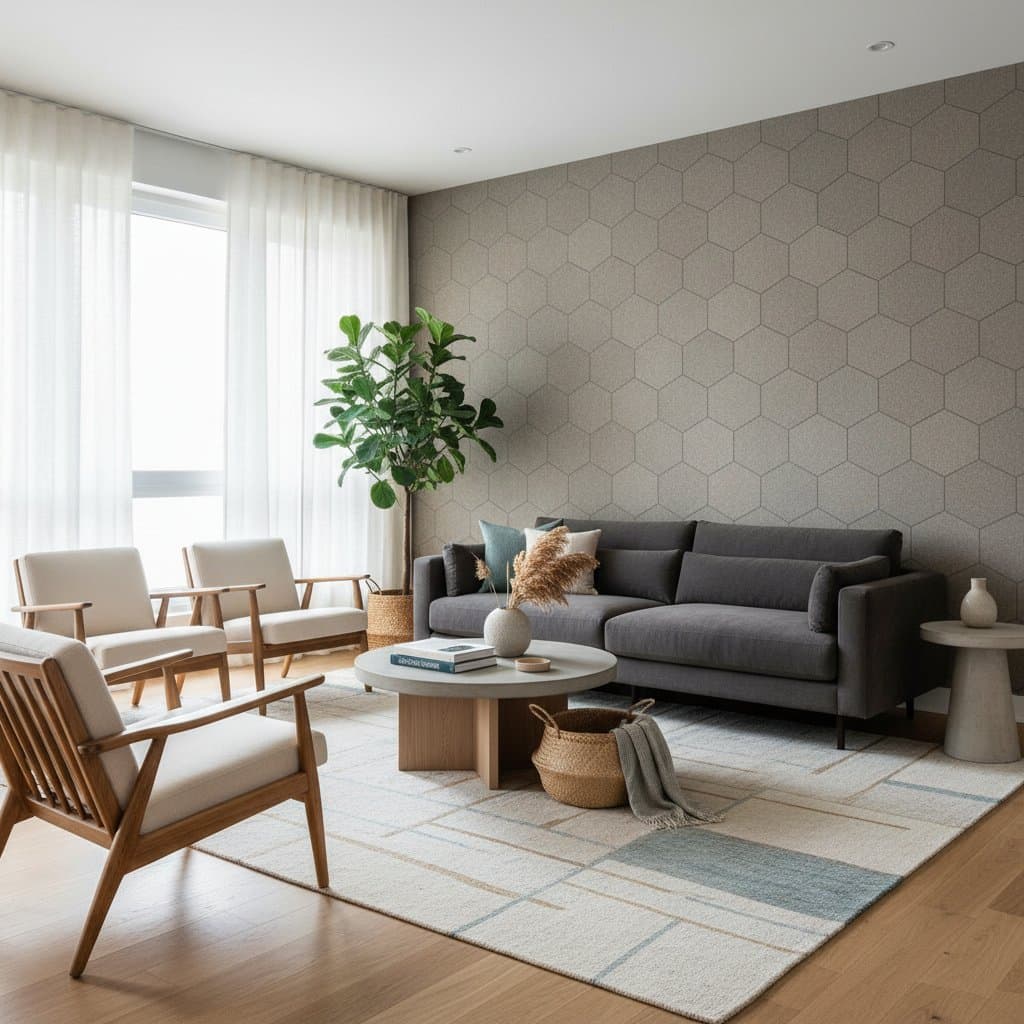
These panels feature various finishes, including fabric coverings and wood veneers. They effectively capture mid-range and high-frequency sounds, thereby controlling reverberations while contributing warmth to the visual scheme. Neutral shades such as soft gray or oatmeal integrate smoothly with modern interiors. For a more striking effect, patterned variants function as overhead artwork.
Homeowners frequently describe these panels as the essential component completing their decor. Upon installation, the room achieves a sense of completion beyond mere furnishing.
2. Wood Slat Systems
Wood slat ceilings introduce pattern and dimension. An acoustic backing material positioned between slats performs sound absorption discreetly, while the wood elements provide natural texture. The result combines warmth with sophistication, reminiscent of upscale hotel lounges.
Such systems assist in delineating areas within open-plan layouts. A slatted section over the seating zone distinguishes it from adjacent dining spaces without constructing barriers.
3. Suspended Acoustic Clouds
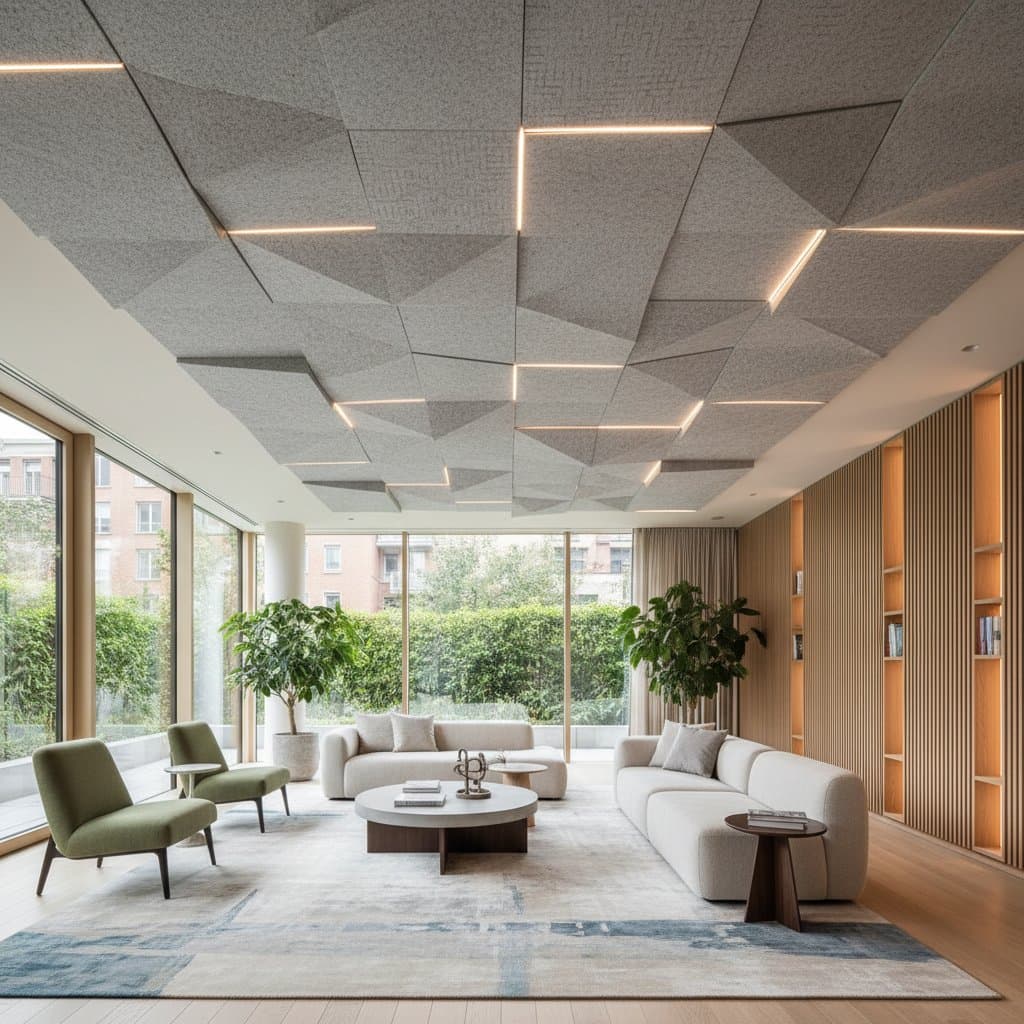
In rooms with elevated ceilings, suspended panels or clouds lower the acoustic profile effectively. Positioned strategically above conversation or media zones, they target noise absorption precisely. Their form evokes sculpture, serving an artistic purpose, and they accommodate embedded lighting or cabling.
Strategic placement of several clouds moderates echoes in expansive lofts while preserving openness.
4. Paintable Acoustic Tiles
These tiles suit preferences for adaptability. Apply any paint color to align with wall hues or establish contrast. Distinct from conventional tiles, they manage sound without evoking commercial settings.
Regard them as reliable performers in ceiling applications: understated, efficient, and versatile.
5. Integrated Lighting Systems
Certain acoustic ceilings incorporate LED channels or pendant fixtures. This merger of illumination and sound management streamlines planning and maintains a tidy appearance. Avoid additional penetrations or visible seams.
A gently lit acoustic ceiling fosters intimacy during evening assemblies, with lighting that enhances features and acoustics that support interaction.
6. Eco-Friendly Materials
Acoustics now align with environmental priorities. Options crafted from reclaimed wood fibers, cork, or sustainable felt diminish both sound reflection and ecological impact. They appeal to those seeking balance between utility and responsibility.
Sound reduction proves compatible with conscientious choices.
Matching Style and Substance
Selection of an acoustic ceiling aligns with aesthetic objectives and daily routines.
- For contemporary minimalist environments, select seamless plasterboard with fine perforations. These maintain a crisp profile while delivering sound control.
- For rustic or organic settings, opt for wood slats or cork panels to introduce tactile elements.
- For dynamic artistic areas, combine forms and tones. Hexagonal or round panels create geometric motifs that serve as focal art.
- For temporary modifications in leased properties, choose detachable tiles or lightweight suspensions that bypass structural alterations.
Each choice carries unique appeal, united by the purpose of enhancing habitability through refined acoustics.
Quick Fixes While You Plan
Prior to committing to a comprehensive ceiling renovation, implement interim measures for noticeable gains.
- Introduce an expansive area rug or multiple fabric layers to capture lower-level sounds.
- Mount acoustic panels disguised as artwork to complement existing palettes.
- Fit substantial draperies to block external sounds.
- Select furniture with soft upholstery over rigid materials.
These interventions yield prompt enhancements, previewing the potential of a dedicated acoustic ceiling.
Living with the Upgrade
With an acoustic ceiling installed, individuals often reduce television volume or forgo ambient audio. Discussions proceed with greater ease. Footsteps register softly. Even utensil contact sounds muted rather than abrupt.
Quiet intervals gain prominence, such as the subtle appliance hum or paper's gentle turn, free from auditory competition.
Upkeep remains straightforward. Dust most panels periodically using a microfiber tool or soft vacuum. For fabric or wood surfaces, consult producer guidelines, though care parallels standard ceiling maintenance.
Realizing the Benefits in Daily Use
An acoustic ceiling operates unobtrusively. It conveys assurance upon entry, through acoustics that envelop sounds appropriately.
Commitment to auditory refinement parallels practical enhancements like silent cabinet mechanisms or task lighting. Though not ostentatious, the improvement proves indispensable once experienced.
The living room evolves beyond a display for decor. It functions as a genuine habitat for communication, repose, and reflection, unhindered by intrusive noise.
Such refinements redefine domestic luxury. They emphasize simplicity, serenity, and the quiet fulfillment of an environment attuned to its occupants.